

Why one overhead light is never enough
Walk into most living rooms in the UK and you will find the same arrangement: a single central fitting, switched from one point beside the door. It does the job, but nowhere near as well as it could.
The problem with one overhead source is not its brightness. It is its position. Light from directly above flattens a room, removing the shadows that give objects their form and the depth that makes a wall colour interesting. A well-lit room is not necessarily a bright one. It is a room where light comes from several sources at different heights, each doing a different job.
This is layered lighting, the technique interior designers apply as a matter of course, and the biggest improvement most living rooms can make without any structural changes.
The three layers: what they are and what they do
Layer one: ambient light
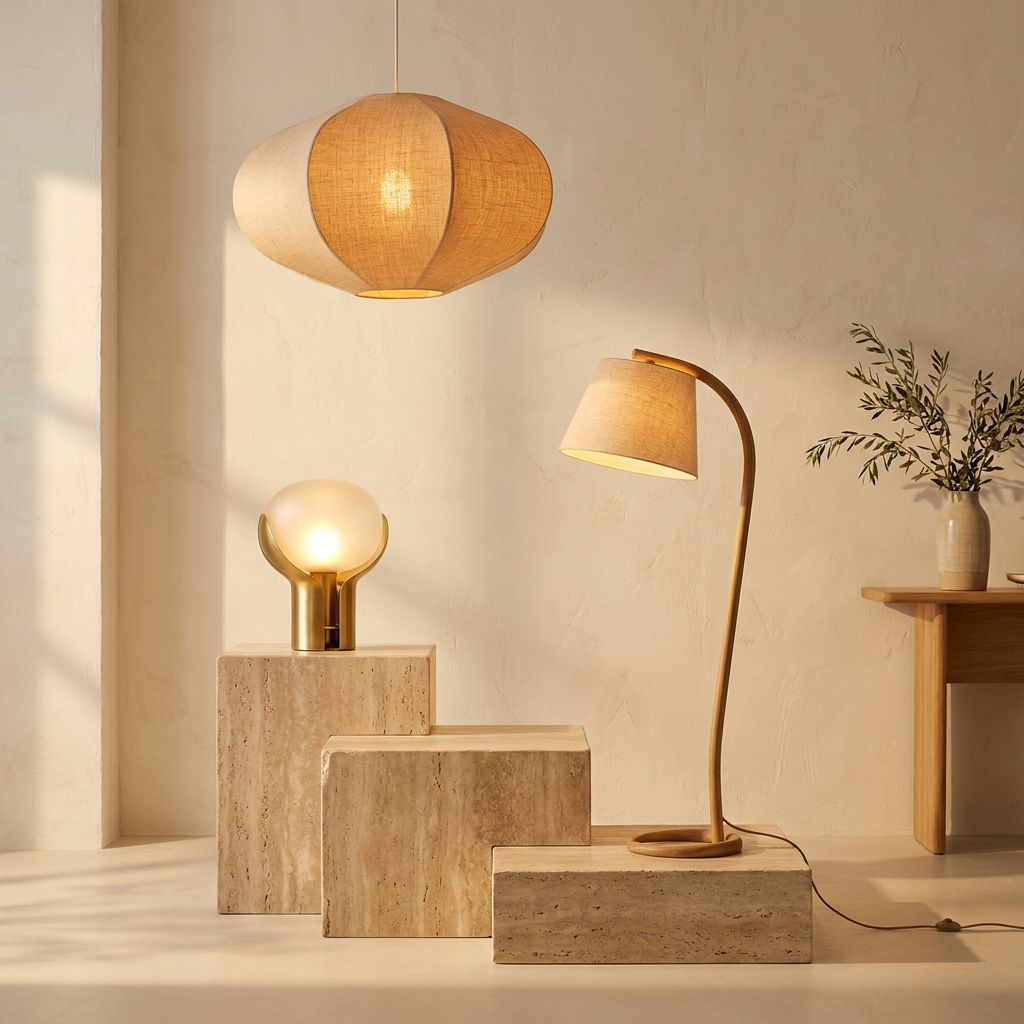
Ambient light is the room's baseline illumination. In a living room it most often comes from a central pendant or recessed downlights, sources that spread light broadly rather than directing it to one point.
The goal is not to illuminate every corner equally. It is to establish the room's mood from above. A pendant on a dimmer, set to 60 to 70 per cent in the evening, fills the room with enough light while still allowing the lower layers to contribute. At full brightness, the same fitting serves daytime tasks.
The material and form of the shade shape what the light does. A stone pendant such as the Tove Travertine Pendant or the Lune Alabaster Pendant gives a warm, soft, intimate glow, which works well in rooms where warmth and restraint are the design language.
Layer two: task light
Task light is directed light for a specific activity. In a living room the most common task is reading, and reading in low ambient light is where many living rooms fall short.
The fix is a floor lamp positioned beside or slightly behind the reader's shoulder, angled toward the page or screen. It directs light where it is needed without affecting the rest of the room, and it adds a warm point of interest to an otherwise empty corner.
Task light can also serve secondary surfaces: a console table behind a sofa, a home office corner in an open-plan room, or a kitchen peninsula at the far end of a combined space. Direct light at the working surface, keep it independent of the main switch circuit, and keep the colour temperature consistent with the rest of the scheme.
Layer three: accent light
Accent light is the layer most people add last and undervalue most. It does not illuminate the room. It gives the room dimension.
A table lamp behind a sofa casts a warm glow upward onto the wall. A wall light that washes a painted surface creates depth and shadow. A small lamp on a bookshelf draws attention into a corner that might otherwise feel flat. These sources make a room feel considered, layered and alive after dark.
Accent light is also where character enters the scheme. A sculptural pendant such as the Kumo Organic Pendant, hung low over a corner reading nook, makes a point rather than simply providing light, and the Sena Pleated Silk Pendant glows softly from within.
Colour temperature: get this right and everything else gets easier
Colour temperature is measured in Kelvin (K) and describes the warmth or coolness of a light source. For living rooms, work within 2700K to 3000K, warm white.
2700K produces a noticeably warm, amber-tinged glow that reads as intimate and relaxed. 3000K is still warm but slightly crisper, and renders colours more accurately, which helps in rooms with deep greens or terracotta.
The most important rule is consistency. A living room with a 2700K pendant, a 4000K floor lamp and a 3000K table lamp reads as incoherent. Buy all your bulbs from the same temperature range and the scheme holds together. Our pendant light bulb guide explains how to choose.
Dimmers: the most underrated element in a lighting scheme
A dimmer does not simply reduce brightness. It changes the character of a room. The same pendant at full output on a Sunday afternoon and at 40 per cent on a Tuesday evening are two different experiences.
Fit dimmers wherever the circuit and fittings allow. Most modern LED fittings are dimmer compatible, but check before buying, as some LED drivers do not dim gracefully and will flicker at lower settings.
For a living room, the ideal arrangement has the main pendant on its own dimmer circuit, and the accent lamps either on a secondary dimmer or on smart plugs for remote control.
Putting all three layers together: a practical example
Take a 4m x 5m rectangular room with a standard 240cm ceiling, a sofa group in the centre and a window wall on one side.
Ambient layer: a single pendant over the centre of the seating group, with a warm white 2700K LED and a dimmer. If it hangs over a coffee table, 140 to 160cm above the table surface is the usual guidance.
Task layer: a floor lamp beside the armchair furthest from the window, angled toward reading height, or a small table lamp on the side table beside the sofa.
Accent layer: a table lamp on the console behind the sofa, or on a shelf at the far end of the room. A wall light on the chimney breast serves the same purpose.
The result is a room that works equally well at midday and at 10pm, not by using different fittings, but by adjusting the output of the layers already in place.
You do not need to buy everything at once. Start with the ambient layer, the pendant, and build outward. Browse the Auren pendant collection, or read our guide on how to choose a pendant light if you are still deciding on the centrepiece.
Frequently asked questions
What is layered lighting?
Layered lighting means using multiple light sources at different heights and for different purposes, rather than one central overhead fitting. The three layers are ambient (general illumination), task (directed light for specific activities) and accent (light that adds depth and personality).
How do I start layering lighting if I only have one ceiling point?
Start by adding plug-in floor lamps and table lamps. These need no new wiring and immediately introduce the task and accent layers. A floor lamp beside a reading chair and a table lamp in the corner will change the feel of a room without any electrical work.
What bulb temperature should I use for a living room?
Warm white at 2700K is the most widely recommended choice. Use the same temperature across all your light sources for a coherent, settled feel.
Do I need a dimmer switch for layered lighting to work?
Not strictly, but dimmers unlock the full range. With a dimmer on the main pendant, you can run the room bright by day and lower it in the evening, letting your lamps do more of the work. It is worth fitting one if you are installing a new pendant.
How high should a pendant light hang in a living room?
Where there is no table beneath it, a pendant used as a general ambient source typically hangs high enough to stay out of the eyeline of anyone standing. Over a coffee table, 140 to 160cm above the surface is the usual guidance. Our pendant height and spacing guide covers this in detail.