

The bedroom lighting problem most people do not realise they have
The average UK bedroom has one central ceiling light, two bedside table lamps and, if there is space, a floor lamp in the corner. The table lamps are functional. The ceiling light is used for getting dressed. The floor lamp rarely gets turned on at all.
This is not bad lighting. It is unthought lighting. The pieces are present but have not been arranged to do what a bedroom needs: help you wind down in the evening, light your book without waking a partner, and make the room feel like a retreat.
The most transformative single change in many bedrooms is moving the lamp off the surface entirely.
The bedside wall light: the upgrade most bedrooms need
A table lamp on a bedside table is convenient. A wall-mounted bedside light is better in almost every way.
A lamp on a surface competes with everything else there: the book, the glass of water, the phone charger. The surface gets crowded and the light ends up at the wrong angle.
A wall light mounted at roughly 140 to 150cm from the floor, or 60 to 70cm above the mattress, directs light onto a book or phone and not into a partner's eyes. It frees the bedside surface and gives the room a considered, hotel-quality finish.
Add a dimmer and you have bedside lighting that works as a reading light at 80 per cent and as a gentle glow at 10 per cent when one person is settling to sleep while the other is still awake.
Pendant lights in the bedroom: when and how
Pendant lights belong in bedrooms more often than people expect. In a bedroom with a ceiling height of 250cm or more, a pendant gives the room a focal point and a sense of vertical proportion.
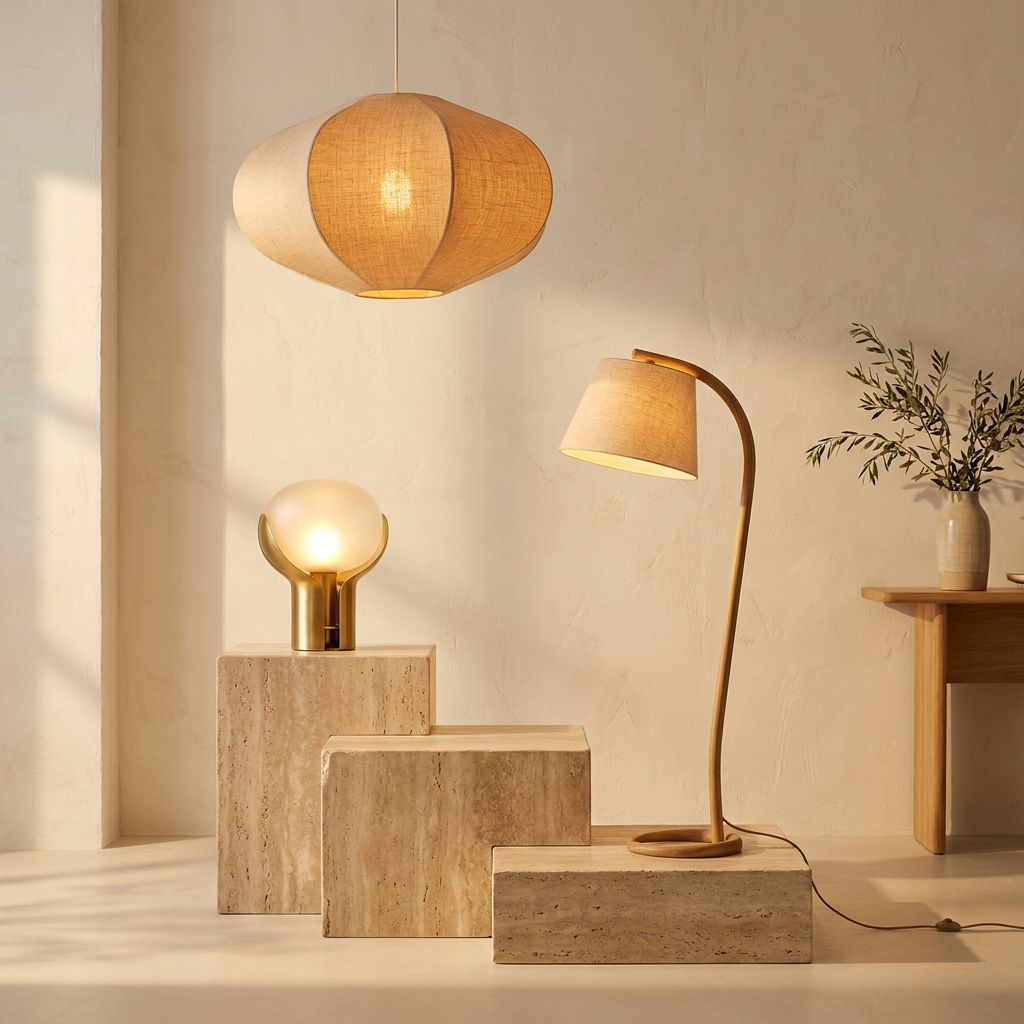
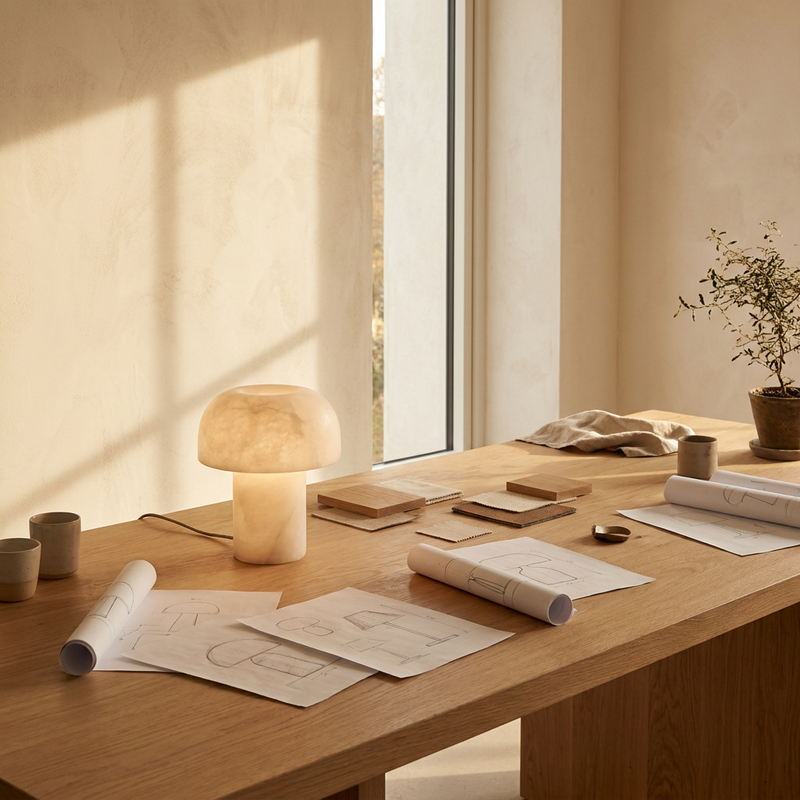
The key is scale. A bedroom pendant should be smaller and quieter than its equivalent in a dining room. The Tove Travertine Pendant, with its low 7cm profile and natural travertine texture, sits well where the palette runs to natural tones. The Lune Alabaster Pendant (Ø14 x H15cm) is small enough to hang either side of a bed, and its diffused, glowing light is inherently restful. The Sena Pleated Silk Pendant, from 30cm, suits a bedroom that wants softness.
Drop length matters more in a bedroom than almost anywhere. A pendant that hangs too low over a bed is both awkward and a practical obstacle. As a general guide, keep the bottom of the fitting well clear of the headboard and of anyone sitting up in bed. Our pendant height guide has the full measurements.
Table lamps for dressers and consoles
While wall lights free the bedside table, table lamps earn their place elsewhere: on a low dresser, a console against a wall, or a windowsill shelf.
In these positions a lamp is an accent source. It is there to create warmth and depth in a corner that would otherwise read as flat. A lamp on a dresser with a mirror behind it doubles the glow and makes a room feel larger and more atmospheric.
Soft, diffusing materials such as silk, linen and alabaster suit a bedroom better than clear glass or metal shades, which produce harder, more directional light.
The overhead light question
Many people who take bedroom lighting seriously end up switching off the central ceiling light in the evening and relying on the layers beneath it. But most bedrooms still need some overhead light for getting dressed and finding things in wardrobes.
The compromise is a ceiling pendant on a separate dimmer: bright in the morning, off in the evening when the wall lights and accent lamps take over.
Replacing a basic flush fitting with a considered pendant is one of the highest-impact changes you can make. It turns a room that is lit into a room that is designed.
Colour temperature and the bedroom
2700K is the right choice for almost every bedroom source. It is the warmest end of the warm white range and signals relaxation rather than alertness. Cooler bulbs, anything above 3000K, push the room toward the register of a bathroom or office, which is the wrong direction for a space that needs to support sleep.
Bringing every bulb to the same 2700K in one pass is the most coherent improvement you can make. Mismatched temperatures, warm overhead and cool bedside, feel subtly uncomfortable even if you cannot say why. Our bulb guide explains more.
A practical scheme for a standard double bedroom
In a typical 3.5m x 4m double bedroom:
Ceiling: a single pendant, centred over the bed or the room, on a dimmer. Full output in the morning, off by the evening.
Bedside: two wall lights mounted at around 145cm from the floor, each on its own switch or a two-way dimmer, with 2700K bulbs.
Accent: one table lamp on the dresser or console, switched independently, to add warmth to the lower half of the room.
Three sources, three layers, one coherent room. See the Auren pendant collection for bedroom centrepieces, and our guide to choosing a pendant light if you are starting from scratch.
Frequently asked questions
What is the best lighting for a bedroom?
A central pendant or ceiling light on a dimmer, bedside wall lights at roughly 140 to 150cm from the floor, and one accent lamp elsewhere. All sources at 2700K warm white, with dimmers at least on the bedside circuit.
Where should wall lights be positioned beside a bed?
Typically 140 to 150cm from the floor, or about 60 to 70cm above the top of the mattress. That puts the light at the right height for reading when sitting up in bed without glare toward a sleeping partner.
Can I use a pendant light in a bedroom?
Yes. A pendant over the bed works as a central ambient source and gives the room a clear focal point. Choose a modest size and keep the drop well clear of the headboard. Refer to our pendant height guide for calculations based on your ceiling height.
Should I use warm or cool light in a bedroom?
Warm white at 2700K. Cooler temperatures of 4000K or above are associated with alertness rather than rest and work against the purpose of the room.
Why is bedroom lighting so important?
Because the bedroom is the one room where atmosphere matters more than function. The quality of the light affects how easily you relax and how the space feels as a retreat from the rest of the house.